Cyber Security Services, 16th November 2026
Why Financial Firms Can’t Afford to Leave IT & Cyber Security to Chance
A computer going down is inconvenient for almost any business. For a financial firm, an unavailable system, compromised email account or stolen set of credentials can quickly become something much more serious that can have lasting consequences.
Financial firms rely on technology to access client records, communicate highly sensitive information, process transactions, manage investments, approve payments and provide services their clients may need access to every day.
At the same time, they hold exactly the type of financial, personal and commercially sensitive information that cyber criminals want access to for further targeted attacks or to sell on the dark web.
Like with all businesses, IT and Cyber Security is the responsibility of the entire business, not a single department. Unfortunately, cyber security is often only looked at when something goes wrong. However, the cost of remediation and to reputation is a LOT higher than protection.
For accountants, financial advisers, insurance brokers, lenders, wealth managers and other businesses operating across the financial services sector, Managed IT and Cyber Security should form part of the firm’s wider approach to risk, resilience and client protection.
Why is Cyber Security so important for Financial Firms?
Financial firms hold large volumes of valuable information and often have access to systems that can be used to move or manage money.
This makes compromised devices, user accounts, phishing emails, fraudulent payment requests, ransomware, data theft and unauthorised access particularly concerning.
The UK Government’s Cyber Security Breaches Survey 2025/26 found that 43% of UK businesses had identified a cyber security breach or attack during the previous 12 months. This increased to 65% of medium-sized businesses and 69% of large businesses. Phishing remained the most common type of attack, affecting 38% of businesses overall.
For financial firms, somebody gaining access to an employee’s Microsoft 365 account could potentially mean access to far more than their emails.
Depending on the user’s permissions, that account could provide access to client information, financial documents, wider business SharePoint files, internal communications, cloud applications and other systems used throughout the business.
This is why modern cyber security needs to protect identities, devices, data and applications rather than relying on traditional antivirus software and a firewall alone.
Financial Services Cyber Security is also about Operational Resilience
Cyber Security is not just about preventing somebody from accessing your systems. Cyber Security forms an essential part of your Business Continuity and Resiliency strategy, ensuring your firm can continue operating when technology fails or other incidents/natural disasters occur.
For FCA-regulated firms (Financial Conduct Authority) that fall within the scope of its operational resilience requirements, the FCA expects firms to identify important business services, understand the technology and other resources supporting them and establish how much disruption can be tolerated. Firms are also expected to test their ability to remain within those impact tolerances during severe (but plausible) disruption.
For many, this changes the question from:
“How do we stop something going wrong?”
to:
“How do we identify risks, prevent problems, detect them quickly and keep the firm running if something does happen?”
That could mean having resilient internet connectivity, reliable cloud services, tested immutable backups, documented recovery procedures (that exist beyond your business network), alternative ways for employees to work and the support of an IT team such as ourselves who are capable of responding quickly if something happen that requires your business continuity strategy to be activated.
The ICO (Information Commissioner’s Office) takes a similar approach to personal data. UK GDPR requires appropriate technical and organisational security measures and specifically considers the confidentiality, integrity and availability of systems and information. Businesses should also be capable of restoring access to personal information in a timely manner following a physical or technical incident. Backups sitting somewhere in the cloud are not enough. You need to know that they are encrypted/protected, that they work and how long it would take to recover.
How does Managed IT & Cyber Security benefit Financial services?
Managed IT
Managed IT provides ongoing management, monitoring and support for the technology financial firms depends on every day.
Rather than waiting for an employee to report that something has stopped working, a managed IT service providers such as ourselves can proactively monitor devices, systems and services, identify potential problems, deploy remote fixes and manage the technology environment as it changes.
This can include everything from Microsoft 365, Endpoint Management and Security Patch Management to Physical Infrastructure, Cloud Services, Backups, Networking, User & Access Management and general day-to-day IT support.
This is incredibly important as employees regularly join or leave. Laptops are replaced/updated. Applications change. Permissions are granted. Software or Operating Systems reach end of support. New cloud applications are introduced, and much more.
Without somebody continuously managing that environment, Shadow IT forms, resulting in small gaps that can gradually become significant risks.
The FCA’s Cyber Coordination Group has specifically highlighted the risks associated with legacy and end-of-life technology and the importance of effective vulnerability and patch management within financial services.
Managed IT from certified engineers with long standing experience in the financial sector ensures that somebody is continually asking:
- Is this device secure?
- Is this software supported?
- Does this person still need access?
- Was that security update installed?
- Are the backups working?
- Is there a better way of doing this?
That is a very different approach to simply having someone available to fix a laptop when it breaks.
Managed Cyber Security
Where IT Support helps keep your technology working. Managed Cyber Security continuously works to protect it and the data your business holds.
A comprehensive Managed Cyber Security strategy could include Endpoint Detection and Response, Cyber Security Operations Centre monitoring, Multi-Factor Authentication, Identity and Access Management, Vulnerability Management, Secure Email Protection, Zero Trust controls, Security Awareness Training, Proactive Threat Monitoring and much more.
For example, Endpoint Detection and Response can identify suspicious behaviour taking place on a laptop even where traditional signature based antivirus software may not recognise the threat. Identity controls can restrict what an attacker is able to reach if an account becomes compromised, whilst also reducing the threat of data misuse within the business. A Cyber Security Operations Centre can investigate suspicious activity rather than relying on somebody within the firm noticing it first.
Vulnerability management and patching can help close weaknesses before somebody has the opportunity to exploit them.
Each control performs a different role, but together they create multiple layers of protection around your business.
Your employees are both your weakest link and your strongest lines of defence
Technology can stop a huge number of threats, but people remain an important part of any cyber security strategy.
Phishing continues to dominate the cyber threat facing UK businesses. Among businesses that identified a cyber breach or attack in the Government’s 2025/26 survey, 88% had experienced phishing as a factor of this cyber attack.
For a financial firm, a convincing email could appear to come from a client requesting a payment, a senior employee asking for an urgent transfer or Microsoft asking somebody to reauthenticate their account.
The National Cyber Security Centre warns that phishing can be used to steal passwords, deliver malware or convince employees to transfer money.
Regular cyber security awareness training and practical simulations must therefore sit alongside technical controls. Employees should understand how to identify suspicious communications, verify unusual financial requests and know exactly what to do when something does not look right. More importantly, reporting a suspicious email should be encouraged.
It is far better for your IT team to investigate ten legitimate messages than for somebody to ignore the one that was not.
Cyber Security also extends to your suppliers
Very few modern financial firms operate entirely using technology they own themselves. Microsoft 365, cloud accounting platforms, financial applications, payment systems, CRM platforms, file-sharing services and other technology may all form part of the firm’s day-to-day operations. However, the use of third-party tools whose security exist beyond your control can create third-party risk. In 2026 a widespread hack of Salesforce impacted businesses around the world. Attackers largely targeted business environments that had been misconfigured, with compromised tokens, elevated user permissions that were not required and much more. However, this is just one example of how a third-party provider’s service can be breached if the correct security and policies are not put in place or actively managed.
The FCA reported in March 2026 that more than 40% of cyber incidents reported to it during 2025 involved a third party. It has subsequently confirmed new operational incident and third-party reporting requirements, which are due to come into force on 18 March 2027.
The FCA is also clear that outsourcing does not remove a firm’s responsibility for protecting customer data or managing the risks associated with third-party providers. Your cyber security strategy therefore needs to look beyond the four walls of your business. Understanding which suppliers support critical processes, what information they can access and what would happen if their service became unavailable is an important part of modern IT management.
Supplier compliance with industry standard regulations and certifications such as Cyber Essentials, Cyber Essentials Plus and/or ISO27001 can be a significant factor in forming a secure supply chain. We are seeing more businesses across all industries now being asked to prove they comply with Cyber Essentials, Cyber Essentials Plus and/or ISO27001 as part of contract tender processes, or as part of an approved supplier programme.
Cyber Compliance should be a year-round consideration
Cyber Compliance is considerably easier when the required security controls, documentation and evidence are managed and gathered consistently throughout the year.
Rather than reaching an annual assessment or audit and suddenly discovering unsupported software, missing devices, excessive permissions or outdated documentation, ongoing Compliance Management can help identify issues as your environment changes. Frameworks such as Cyber Essentials, Cyber Essentials Plus and ISO 27001 can also provide businesses with structured ways of improving and demonstrating their approach to information security. They don’t replace FCA requirements or UK GDPR obligations, but they can form an important part of a wider cyber security and compliance strategy that can be demonstrated to clients and prospective clients alike.
Cyber Essentials focuses on five fundamental technical controls, while Cyber Essentials Plus independently tests that those controls have been correctly implemented.
TwentyFour is an official Cyber Essentials and Cyber Essentials Plus Certification Body, licensed and assured by IASME to assess businesses and issue certification.
Combined with ongoing Compliance Management, this allows firms to work towards certification while continuing to maintain the controls supporting it throughout the year.
Who is planning your Financial Firm’s technology strategy?
Technology changes so quickly that it can sometimes be difficult to keep up with. What was the latest and greatest tech 5 years ago, could be out of date an unsupported today. As such, there is a bigger question that businesses should be asking themselves when it comes to planning their IT strategy. It is not important to ask yourself “are my IT systems working today” you should be asking yourself;
Will they still support your business next year? Or in three years time?
Technology decisions can have long-term implications for cost, security, compliance and productivity. Replacing aging infrastructure, moving applications into the cloud, implementing AI, introducing new financial platforms or opening another office should not be isolated IT decisions. They should form part of the firm’s wider business growth strategy.
Through vCIO strategic guidance, TwentyFour works with businesses to review their technology environment, understand upcoming requirements and develop a technology roadmap that supports their longer-term goals.
That means considering where investment is required before something becomes an emergency, identifying systems approaching end of life and ensuring that security and compliance requirements are considered as the business develops.
Good IT should not simply support where your financial firm is today. It should help you prepare for where it is going next.
What should Financial Firms look for in a Managed IT and Cyber Security Provider?
Your IT provider potentially has significant access to your business, so choosing one should be treated as an important risk decision.
Financial firms should look beyond response times and pricing.
Consider whether your provider understands your industry, can support your wider cyber security requirements, monitor threats, manage endpoints, maintain security updates, support compliance, protect identities, manage backups and help develop your longer-term technology strategy.
Beyond this, they should also be capable of clearly explaining the risks they identify in a relatable way to the potential impact on your business. You should not need to understand every technical term and abbreviation to understand whether your business is protected.
If you are hearing;
“Your IAM need to have stronger PIM and PAM implementation backed by MFA as part of your ZTNA and ZTCA policies.”
Ask yourself why you are not hearing;
“We recommend that you review your employee access policies to ensure that users only have access to the tools and data they need to do their roles effectively. Users who have more access rights than are required can present an unnecessary security risk. It is also advised that employees have additional levels of authentication to prove they are the ones trying to access your sensitive systems and data regardless of if it is on their computer, in your business or through an online portal.”
The FCA itself expects firms to maintain systems and controls designed to minimise the risk of operations and information assets being exploited by thieves and fraudsters, including controls designed to protect customer information from unauthorised access. Managed IT and Cyber Security providers (such as ourselves) should be helping you achieve that objective, not simply closing support tickets.
Does your Financial Firm have the right IT and Cyber Security in place?
Financial firms depend heavily on technology, but that dependency should not become a vulnerability.
The right Managed IT and Cyber Security strategy can help your firm remain productive, protect sensitive client information, reduce cyber risk, strengthen resilience and maintain greater visibility over your compliance requirements.
At TwentyFour, we bring Managed IT, Cyber Security, Compliance Management and strategic vCIO guidance together to give businesses a complete view of their technology environment.
Rather than waiting for something to go wrong, we work proactively to identify weaknesses, manage your systems, strengthen your security and help your technology support the future of your business.
If you are responsible for an accountancy practice, financial advisory firm, insurance business, wealth management company or another business within financial services, speak to TwentyFour about reviewing your current IT and Cyber Security environment.
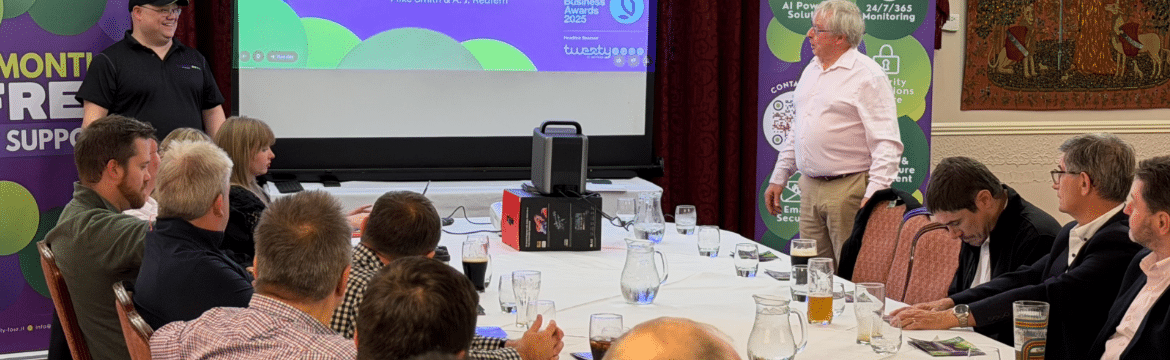
We have been working with businesses within the financial sector for more than 20 years, also working with the ICAEW (Institute of Chartered Accountants in England and Wales) to deliver a range of educational talks to its members around topics of Cyber Security, AI & Data Security.
Book a meeting with TwentyFour and find out whether your technology is providing the security, resilience and support your financial firm needs.
Enquire HereRecent Insights