Cyber Security Services, 14th September 2026
How often should your team take Cyber Security Awareness Training?
Whilst it is important that your business has the right security tools and policies in place. Did you know that your people could be one of your strongest lines of defence against cyber attacks?
Well, that is only if they are given the knowledge, confidence and regular training needed to recognise the ever evolving cyber security threat landscape.
But how often should cyber security awareness training happen?
Answer: Regularly
But what does regular cyber security training involve?
For most businesses, the answer should include a baseline of training during induction/employee onboarding, regular monthly awareness activities throughout the year, targeting changes and new risks in the industry and a formal refresher at least annually where any knowledge gaps are identified to help focus training programmes in the year ahead. This can also then be paired with random real-world tests, such as phishing simulation attacks.
Whilst annual training provides a useful baseline, it shouldn’t be the only time cyber security is discussed.
What is Cyber Security Awareness Training?
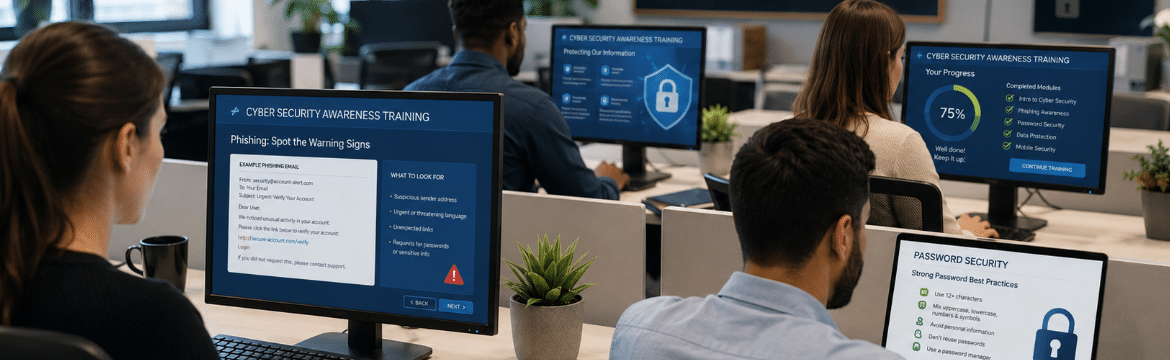
Cyber Security Awareness Training helps people understand the day-to-day cyber risks they may encounter and what they should do when something does not look right.
Regular training modules should cover subjects such as phishing, email impersonation, suspicious links, password security, Multi-Factor Authentication (MFA), safe device use, data handling, file sharing, new threats that have been identified that could potentially impact the business and the correct process for reporting potential concerns.
Cyber criminals are using increasingly convincing phishing messages across a variety of platforms (beyond traditional email phishing), fake login pages, QR codes, telephone calls, text messages and AI-generated content to persuade people to share information or perform an unsafe action. Throughout 2025 and 2026 we have also seen a drastic increase in the number of audio and video deepfake style attacks where cyber criminals will use audio and/or video captured from events, talks and online videos to be able to impersonate a person within your business.
Verizon’s 2026 Data Breach Investigations Report identified that the human element was involved in 62% of the breaches analysed. Regular cyber security training and awareness among all employees can drastically reduce these numbers and ensure that your business has a strong and secure foundation to combat cyber threats.
How often should Cyber Security training happen?
Whilst we say that Cyber Security Awareness Training should happen “regularly” There is no single training schedule that will be right for every business. We recommend monthly to ensure consistency in the awareness that is being delivered and ensuring that training covers a wide range of cyber and data security topics. Even regularly refreshing employee knowledge on some topics.
However, the frequency of awareness training should reflect the business, and the types of risks people face, the information they handle, and the responsibilities associated with their role. The Information Commissioner’s Office recommends induction and refresher training for all staff and warns that knowledge becomes less effective when training is not kept up to date. This could mean that businesses implement initial new starter/onboarding training, then monthly or quarterly training or awareness briefs in line with new threats that are identified, then backed by annual reviews and real-world simulations.
The goal is not to catch people out. It is to identify where additional support is needed before a genuine attack reaches them.
Should training be weekly, monthly or annual?
Cyber Security Awareness Training should be ongoing, but that does not mean people need to complete a long training course and knowledge assessment every week.
Although… there are definitely enough topics to cover. We know, we have been releasing weekly articles on all things Tech, AI & Cyber Security for the past 3+ years and host a podcast where we cover the latest news on these subjects.
Short weekly or monthly briefs, paired with monthly or quarterly training modules and assessments can keep security visible without disrupting productivity and help maintain formal records of training for compliance purposes.
Relying entirely on one annual course can lead to “tick-box security”. People may pass an assessment in the moment, maybe taking multiple attempts getting the answers in another browsing window (we’ve seen it happen), but because of this many employees gradually forget important details, they become complacent or fail to recognise newer techniques such as ClickFix Phishing, clickjacking or sophisticated Email Impersonation Attacks.
Regular communication can help address privacy and security fatigue and prevent employees from becoming complacent against newer attack vectors by keeping advice relevant and up to date, without overwhelming people with constant warnings.
What should ongoing training include?
Effective cyber security training should be practical not technical, it should be made easy to understand and connected to situations that people in your business may genuinely experience.
Short training modules can cover subjects such as phishing, password security, multi-factor authentication, secure file sharing, dangers of public wi-fi, why it is important to not plug unknown USB drives into your devices, what ransomware is, how to report suspicious activity and much more. Phishing simulations can help measure how people respond to realistic looking messages with malicious intent. However, it is important that the results are used constructively to help tailor training to the individuals rather than to embarrass or punish them.
Training should also use current examples from the news and emerging attacks. Topics such as the hidden risks of using third-party AI and how uploading company data could be used to train models and provide results on that data to others without you knowing. Or how unmanaged Shadow IT in a business could present risks to cyber and data security.
Different roles and responsibilities within a business may also require different training. Someone handling financial payments may need additional awareness around how phishing can be used for invoice fraud, while people with privileged access should understand the increased risks associated with elevated or administrative accounts.
Management teams throughout the business should have clear visibility over training completion, assessment results, phishing simulation performance and recurring areas of concern to help tailor the training to their teams. By doing so, this turns awareness training into a measurable risk-management activity rather than a course that is completed, a box ticked and the knowledge forgotten.
How does cyber security awareness training support compliance and cyber resilience?
Cyber Essentials and Cyber Essentials Plus focus on essential technical cyber security controls within your business, but those controls still rely on people using accounts, devices and systems correctly. Awareness training helps people understand why protections such as multi-factor authentication, access controls and secure configuration are not only important, but an essential part of being compliant with these certifications.
ISO 27001 takes a wider approach to information security across people, policies and technology. Maintaining training records and responding to identified knowledge gaps can provide useful evidence that information security responsibilities, policies and processes are understood by personnel throughout the business.
When people understand the threats they face, they also know how and where to report something suspicious should it come up. This means that your business has a better opportunity to identify and investigate potential threats before a risk could become more disruptive.
This is an important difference between Cyber Security & Cyber Resilience. Cyber security aims to reduce the likelihood of an attack succeeding, while cyber resilience also considers how quickly the business can recognise, respond to and potentially even recover from an incident.
How can TwentyFour support ongoing security awareness?
Cyber Security Awareness Training should form part of a wider and layered cyber security strategy.
TwentyFour can help businesses deliver ongoing training, phishing simulations, knowledge assessments and clear reporting that gives management teams visibility over awareness levels throughout the business. We also provide additional educational resources here on our own website and through our podcast and social media channels.
However, training is only a small part of the puzzle. We provide a multi-layered zero trust first cyber defence strategy which includes endpoint detection and response, active email threat protection, endpoint management, Identity and Access Management, cyber security operations centre monitoring, compliance management and much more.
By combining trained and informed people with effective technology, policies, monitoring and management oversight, TwentyFour helps businesses establish a secure foundation that continues to evolve as threats change.
Enquire Here