Cyber Security Services, 10th August 2026
Common Causes of IT Downtime for Businesses
Why is Business Downtime more than an IT Problem?
It is something that many business owners worry about, that one thing that causes major disruptions to your business operations.
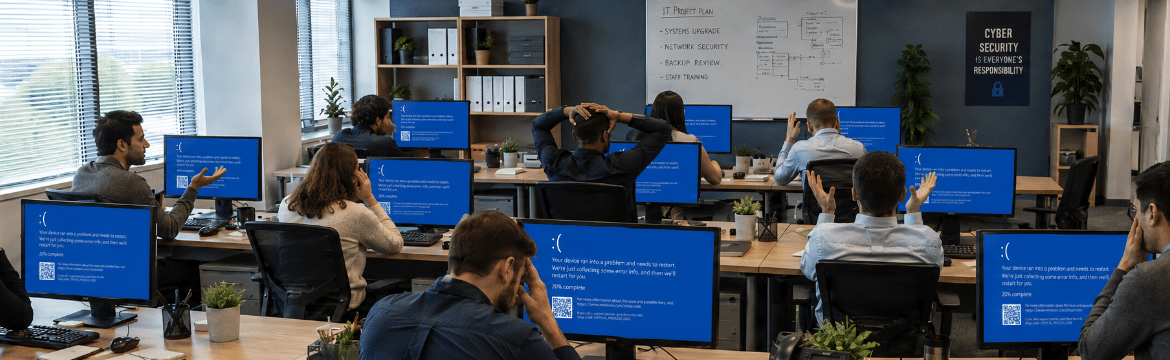
However, that one thing is rarely the only cause of downtime. Yes, downtime can impact, devices, servers, applications and networks. It can also stop employees from working, delay customer service, disrupt wider business operations, create security risks and damage client confidence in your business.
It is important to remember that for many businesses, downtime is not caused by a single major disaster, it often caused by many smaller issues that have not been monitored, maintained or managed properly, paired with a poor business continuity strategy, that all culminate in a much larger issue. This can include, ageing hardware, missed updates, weak cyber security tools (or ones that are not configured correctly for your business), poor backup policies and security, unreliable connectivity and unclear business continuity processes can all create avoidable disruption.
GOV.UK’s Cyber Security Breaches Survey 2025/2026 found that 38% of all businesses in the UK experienced phishing attacks, with 93% of successful cyber breaches starting from a phishing. While Uptime Institute reported that nearly 40% of businesses have suffered a major outage caused by human error over the past three years. These figures highlight a simple reality. Downtime risk is not theoretical. It is something businesses need to understand and actively manage.
What are some of the most common causes of downtime for businesses without managed IT support? And how TwentyFour can help reduce these risks for your business?
-
Reactive IT Support Instead of Proactive Monitoring
One of the biggest causes of downtime, especially for SME’s, is waiting until something breaks before acting. Without proactive monitoring, issues such as storage warnings, failed services, device errors, failed operating system or security updates, backup failures, security alerts or network instability can go unnoticed until they impact business operations.
Without proactive monitoring to prevent these issues from occurring, this approach often leads to avoidable downtime, long resolution times and greater frustration for both employees and clients alike as the business struggles to bounce back. Being reactive to your IT systems can also make IT issues feel unpredictable, because the business is constantly combatting problems as they occur rather than preventing them from growing at the rout.
How TwentyFour Can Reduce Downtime Risk
TwentyFour provides proactive IT support designed to monitor for and identify risks before they can cause disruption to your business operations. Through monitoring, alerting, background maintenance, reporting and 24/7/365 support, we help businesses move away from a “break-fix” approach and towards a resilient managed IT model that not only actively works to prevent downtime but enables your business to succeed through the technology it uses.
Our team can monitor systems, review recurring issues, identify weak points and provide practical recommendations that help reduce the chance of repeated outages.
-
Ageing Hardware and Infrastructure Failure
Old servers, switches, firewalls, wireless access points, laptops and storage devices can all become downtime risks as they continue to age. As technology continues to improve, and operating systems and software shift support to newer systems/solutions, older hardware may become slower, less secure, unsupported by vendors or more likely to fail without warning.
Businesses without managed IT often keep hardware running for too long because there is no clear device lifecycle strategy for desktops, laptops, servers or other critical business infrastructure. Leading to compatibility issues, performance problems, device failures and expensive unplanned emergency replacement projects.
How TwentyFour Can Reduce Downtime Risk
TwentyFour helps businesses understand the health, age and suitability of equipment across their IT infrastructure through a structured Device Lifecycle and Technology Alignment strategy. We can review hardware, identify devices approaching end of life, plan refresh cycles, recommend improvements before failures may occur, and even understand if hardware is suitable for its use case in a business.
This includes infrastructure management, endpoint management, network support, secure Wi-Fi, firewall management and further strategic lifecycle planning through our vCIO board level technology guidance.
-
Poor Patch Management and Missed Updates
Updates are essential for performance, stability and security. However, unmanaged and unmonitored updates can create problems in two ways.
If patches are not applied, systems may remain vulnerable to “Zero Day” exploits or become unstable over time as software and hardware become incompatible if relevant drivers are not kept up to date.
If updates are applied without proper planning, they can interrupt users, cause compatibility problems or also trigger unexpected downtime.
Without a structured patching and updating process, businesses can quickly lose visibility of which devices are secure, which updates have failed and which systems need attention.
How TwentyFour Can Reduce Downtime Risk
TwentyFour supports businesses with managed patching, update monitoring and maintenance planning. Our approach helps ensure critical operating system and security patches are deployed in a controlled way, driver updates are deployed, all whilst conducting our own compatibility testing to reducing unnecessary disruption for users.
We help businesses plan ahead for major platform changes, preparing them for operating system retirement dates, ensuring their technology is in line with our technology alignment guidelines and monitoring for application compatibility risks, ensuring that updates do not become last-minute emergencies and are planned in a structured and secure way to reduce downtime.
-
Cyber Attacks, Phishing and Ransomware
Cyber attacks are one of the most damaging causes of downtime. A phishing email, compromised account, or malicious file can quickly turn into a ransomware attack, causing disruptions across your business, reducing access to systems, data and communications.
IBM’s Cost of a Data Breach Report 2025 found the global average cost of a data breach was $4.4 million. While the cost for each business varies significantly, the wider point is clear. 92% of businesses who are impacted by cyber security incidents take more than 24 hours to recover from an attack, resulting in a loss of work for your employees, loss of business, and loss of trust from your customers/clients. Cyber security incidents can create major operational, financial and reputational disruption that can have lasting effects for months or years to come.
For SMEs, the issue is not just whether data is stolen. It is whether your business can continue to operate, can it recover data following an attack, access files, process orders, communicate with customers, manage finances, and how quickly can all that happen?
How TwentyFour Can Reduce Downtime Risk
TwentyFour provides managed cyber security services designed to significantly reduce the risk of attack to businesses through a multi-layered zero trust first cyber security approach that we also link in with wider disaster recovery and business continuity plans.
This includes managed Cyber Security Operations Centre and monitoring services, Endpoint Detection and Response, zero trust endpoint management, zero trust network and cloud access, identity and access management, multi-factor authentication, email security, vulnerability management, dark web monitoring, backup and disaster recovery, and incident response support.
Cyber protection is more than just about detection. (It even says so on our branded rugby balls.)
By combining prevention, detection and recovery, we help businesses to significantly strengthen their cyber resilience and reduce the likelihood of a cyber incident impacting your business that could then result in prolonged downtime.
-
No Reliable Secure Backup, Disaster Recovery Plan or Business Continuity Strategy
Businesses with unmanaged backup strategies often “set and forget” backups, assuming them to be working until the moment they are needed. Unfortunately, a backup that has not been tested, monitored, correctly configured or secured may not provide the protection a business expects.
Without a reliable backup and disaster recovery strategy that is regularly tested, businesses can lose access to critical files, applications, emails, databases, cloud data and more. This can turn a hardware failure, accidental file deletion, ransomware incident or other natural disaster into a much larger operational problem that could have wider impacts on the future of a business.
How TwentyFour Can Reduce Downtime Risk
TwentyFour not only support businesses implement and manage backup and disaster recovery solutions, we ensure that they are secured and are aligned to your business operational needs. Can’t cope with more than 5 minutes of data loss? Need recovery in under 30 minutes? We work with you to ensure that your solutions meet your business continuity strategy.
This includes secure immutable backups that cannot be targeted by cyber criminals, cloud backups, SaaS backup for Microsoft 365, disaster recovery and business continuity planning, recovery testing and clearly defined recovery objectives. We help businesses understand what needs to be protected, how quickly it needs to be restored and what the recovery process should look like.
The goal is not simply to have a backup. The goal is to have confidence that the business can recover in the event of an unplanned outage.
-
Internet and Connectivity Outages
Modern businesses rely heavily on connectivity. If the internet goes down, staff may lose access to critical systems they need to be able to do their jobs; cloud applications, VoIP phones, Microsoft 365, remote systems, payment platforms, customer portals and much more.
For businesses with only one internet connection, one router or no failover strategy, a simple broadband fault can create significant downtime.
How TwentyFour Can Reduce Downtime Risk
TwentyFour helps businesses design more resilient connectivity through high-availability internet solutions. This can include secondary or even tertiary connections through leased lines, FTTP, FTTC, 4G, 5G, Satellite/Starlink, firewall failover and properly monitored and managed network infrastructure to create automated failover processes.
Our solutions ensure that if one connection fails, the business has a practical backup route to keep their essential services running, automatically returning to their primary connection when services are restored.
-
Microsoft 365 and Cloud Misconfiguration
Cloud platforms such as Microsoft 365 are reliable, powerful and widely used across businesses around the world, but they still need to be configured and managed correctly to ensure that businesses can get the most out of the tools they use and ensure their data and users are secure.
Poor user access permissions, weak account security settings, unmanaged devices, missing backups, incorrectly configured SharePoint structures or incorrect email configuration can not only create downtime but also increase user and business risk. Poorly or misconfigured cloud platforms can introduce data access issues, but they can also impact how effectively your business can operate.
Cloud services reduce the need for some on-premises infrastructure, but they do not remove the need for properly configured IT infrastructure.
How TwentyFour Can Reduce Downtime Risk
TwentyFour supports businesses with the configuration, security and ongoing management of Microsoft 365 and other cloud environments.
This includes Microsoft 365, emails (and email security), SharePoint, Teams, OneDrive, Entra ID, Conditional Access, Identity management, licensing, backup, device access and wider security practices as part of your wider cyber security strategy. We ensure that businesses cloud platforms are easier to use, better aligned to how their teams work and put the security of their business and the data it holds first.
-
Human Error and Lack of Clear IT Processes
Your users are the weakest link in your cyber security strategy and human error is one of the most common causes of downtime. This may include accidental file deletion, incorrect configuration changes, missed procedures, weak account security, clicking phishing links, unplugging equipment, installing unapproved software or making changes without understanding the wider impact.
Uptime Institute’s 2025 outage analysis found that 85% of major outages caused by human error stemmed from staff failing to follow procedures or from flaws in the procedures themselves.
However, it is important to consider that the issue is not always the person. Often, the real problem is that there are no clear processes, no documentation, no change control, no oversight, and by extension no understanding from your team in your IT and Cyber Security policies and strategies.
How TwentyFour Can Reduce Downtime Risk
TwentyFour help businesses reduce human-error risk through education, documentation, change management, access controls, user training, endpoint management, comprehensive security tools and clearly defined support processes.
We help ensure the right people have the right level of access, implementing identity access management (IAM) and pairing it with policies of least privileged access and identity management to ensure that users only access the files and services needed to effetely carry out their role. Changes are handled in a structured manner, are recorded and audited so that users know what to do when something looks wrong. This reduces avoidable mistakes and helps issues get escalated quickly when they happen.
-
Lack of Strategic IT Planning
Without a clear IT strategy, businesses often make short-term decisions without considering the long-term implications or impacts that it can have on a business growth strategy. This can include delaying hardware or system upgrades, choosing systems that may be suitable now but will not be suitable as the business grows, underinvesting in cyber security, ignoring backup and business continuity requirements or simply waiting until equipment fails before replacing it. If it has failed… it’s already too late.
Your IT systems, solutions and strategy should support business growth, not hold it back. When technology isn’t planned properly, it can become a barrier to productivity, efficiency, security and resilience.
How TwentyFour Can Reduce Downtime Risk
At TwentyFour we provide a vCIO service which delivers board level technology guidance to ensure that businesses take a more strategic approach to their IT and Cyber Security solutions. This means constantly reviewing current systems, understanding business goals, identifying risks and creating a practical roadmap for improvement in line with your wider business growth strategy.
Our vCIO support can help with budgeting, lifecycle planning, cyber security strategy, compliance readiness, cloud planning, infrastructure improvements and long-term resilience.
Plan Now To Prevent Downtime
Many downtime risks are avoidable when businesses have the right visibility, support and planning in place. Managed IT is not just about fixing problems when something goes wrong. It is about reducing the chances of those problems happening in the first place whilst preparing for the worst-case scenario.
By combining proactive 24/7/365 IT support, monitoring, managed cyber security, identity access management, cloud management, secure backups, disaster recovery, infrastructure support and strategic guidance, TwentyFour helps businesses build a more resilient IT environment that not only reduces downtime, but to build a reliable technology infrastructure that supports your business growth.
How can TwentyFour support you to reduce downtime risk?
If your business relies on reactive IT support, ageing infrastructure, unmanaged updates or backups, unclear recovery processes or unreliable infrastructure now is the time to review your downtime risk.
TwentyFour IT Services supports businesses throughout the UK with managed IT support, cyber security, cloud services, infrastructure management, secure managed backups, disaster recovery, compliance management and vCIO guidance.
Contact TwentyFour to discuss how we can help reduce downtime risk and keep your business on track to build a better future through its technology.
Enquire HereRecent Insights